


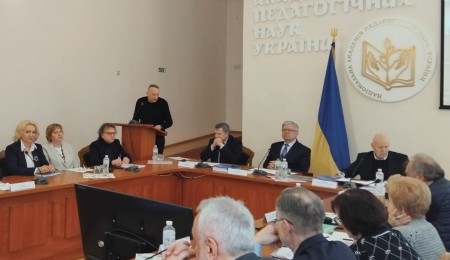
On April 1, a meeting of the Presidium of the National Academy of Educational Sciences of Ukraine was held, at which the issue “On the Results of Research into Didactic Systems of Specialised Secondary Education at the Institute of Pedagogy of the National Academy of Educational Sciences of Ukraine” was presented and discussed.
In 2024–2025, as part of the fundamental research project “Didactic Systems of Specialised Secondary Education” (state registration number: 0124U000447, principal investigator O. Malykhin), the didactic systems of specialised secondary education for various types of educational institutions were substantiated, the theoretical-methodological foundations for their development (methodological approaches, principles, functions) were defined, and the essential components for their effective functioning (objectives, content, forms of organisation, teaching methods and resources, etc.) were identified, taking into account the specific characteristics of each individual type of educational institutions.
As part of the fundamental research project “Didactic Systems of Specialised Secondary Education”, the content of the current regulatory framework governing the provision of specialised secondary education has been analysed.
Contemporary scientific approaches to the study of specialised secondary education are examined, and the main areas of research are identified.
The methodological foundations of modern specialised secondary education are clarified; in particular, the key principles of competence-based, activity-based, person-centred, integrative and systemic approaches are highlighted.
The Western European and North American experience of the successful implementation of specialised secondary education has been studied: the priority is to take into account the individual psychological and individual typological characteristics of learners, their needs, interests and capabilities; the orientation of educational content towards the demands of the country’s economy; a developed structure of content selectivity; multi-level differentiation of teaching; support for individual educational pathways and personalisation of learning. The possibility of adapting these strategies to the Ukrainian educational environment, taking into account current regulatory requirements, has been analysed.
This study examines the state of specialised secondary education in Ukrainian educational institutions under martial law. It identifies the characteristics of blended and distance learning models in specialised education, the challenges of ensuring the stability of the educational process, the uneven access to resources, changes in students’ motivation, and the growing importance of individualisation and supportive educational practices.
The main findings are as follows:
- conceptual model of the didactic system of specialised secondary education has been substantiated at a theoretical and prognostic level;
- didactic systems of specialised secondary education for lyceums, vocational colleges (institutions of vocational (vocational-technical) education), institutions of specialised education (sports, military, scientific lyceums, etc.) and institutions of special education (special schools, educational and rehabilitation centres), institutions of pre-higher vocational education, and other educational institutions licensed to carry out educational activities in the field of general secondary education at the relevant level;
- pedagogic conditions for implementing specialised secondary education systems in educational institutions;
- methods for providing scientific and methodological support for the implementation of specialised secondary education systems.
The findings hold significant scientific and practical potential for the transformation of specialised secondary education in Ukraine in the context of implementing the “Education 4.0” concept and sustainable post-war recovery.
The Presidium approved the research findings whilst emphasising the following:
Further development of methodological support for the application of research findings in educational practice is promising, in particular the development of teaching materials and recommendations for teaching staff at educational institutions providing specialised secondary education.
It is advisable to intensify efforts to present research findings in the international scientific community, in particular by increasing the number of publications in journals indexed in the Scopus and Web of Science scientometric databases.
A direction for further work could be the deepening of inter-institutional scientific cooperation and the coordination of research in the field of specialised secondary education to ensure their comprehensive scientific and methodological support, in particular with educational institutions of various types licensed to provide educational activities for the acquisition of specialised secondary education.
11:10 02.04.2026